
Categories
Living in North MississippiPublished June 8, 2026
The $50,000 Mud Road That Built (and Almost Killed) Hernando, Mississippi


If you’ve spent any time driving through Northwest Mississippi, you already know that Hernando, MS is basically the gold standard for small-town Southern charm. From the bustling historic courthouse square to the pristine, tree-lined historic districts, it’s a community defined by its preservation and curb appeal.
As a local real estate expert, I look at neighborhoods like Elm Street, Commerce Street, or Magnolia Drive and see a highly competitive, low-inventory housing market where average prices easily push past $500,000, and luxury custom builds regularly clear $800,000. People move here from all over the Memphis metro area because they want a piece of this picture-perfect lifestyle.
But if you dig past the modern boutiques, the award-winning farmers' markets, and the top-tier school districts, you find a history that is wilder, darker, and more resilient than almost any other town in the Mid-South.
Back in the 1850s, Hernando had a massive infrastructure crisis. Its entire future was literally melting into the earth.
The 1850s Land Rush and the Problem with Mississippi Dirt
Imagine investing everything you have into a booming frontier town. The Chickasaw Cession land rush of the 1830s and 1840s had brought a wave of wealthy planters and merchants to DeSoto County. Gorgeous historic estates were going up, and Hernando was quickly positioning itself as a primary trade hub just south of Tennessee.
But the town had one fatal flaw: the dirt.
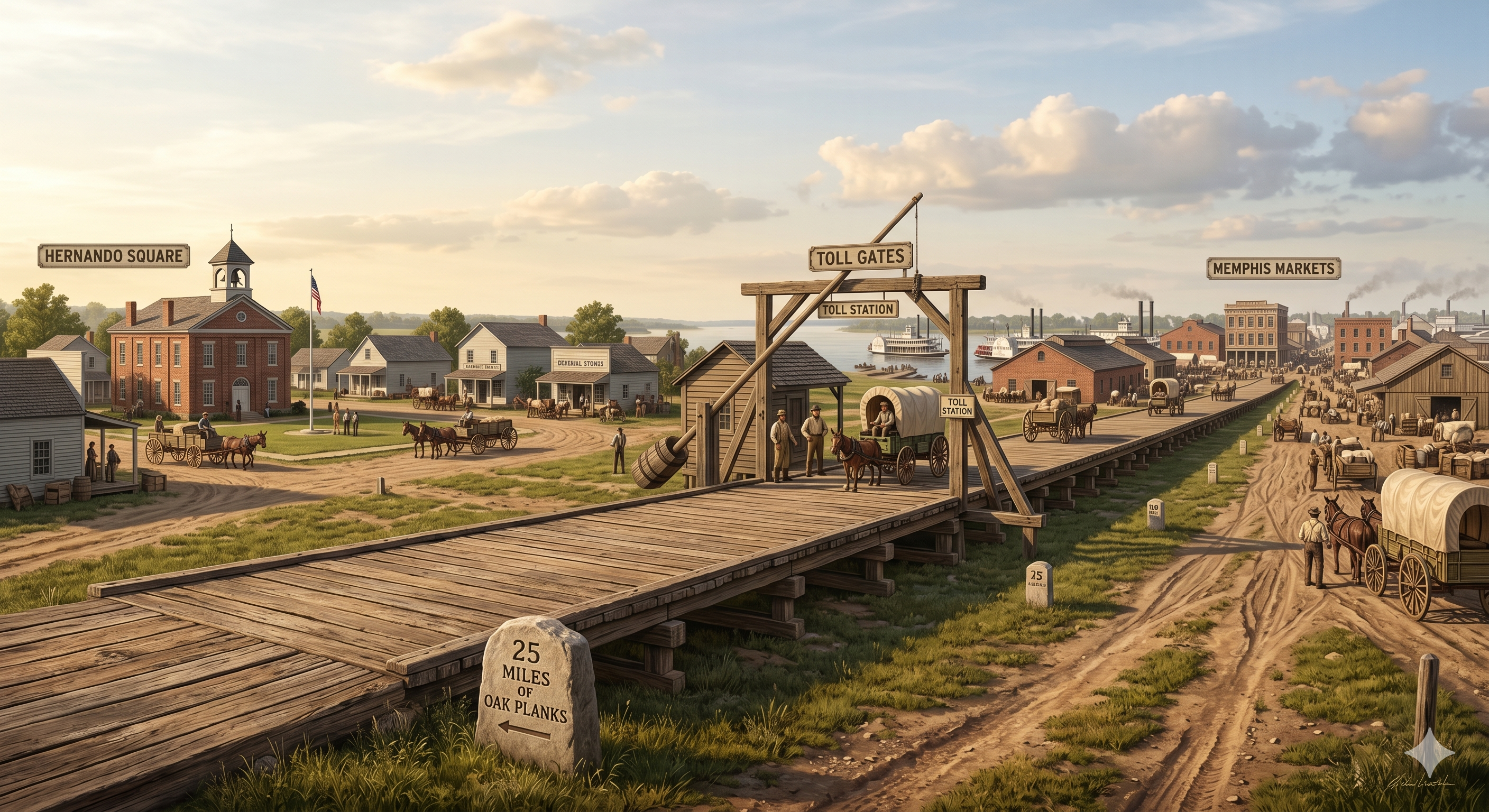
Every single time it rained, the main trade route connecting Hernando to the massive shipping port of Memphis turned into a swampy, wheel-snapping nightmare. We aren’t talking about a few standard potholes here; historical accounts describe mud so deep it could swallow a wagon and a team of mules whole.
For months out of the year, local commerce ground to a violent halt. Farmers couldn't get their cotton to the Memphis markets, and goods couldn't get back down to Hernando stores. It was completely killing business and tanking early property values.
Faced with economic strangulation, the town’s wealthiest leaders came up with a wild, multi-million-dollar gamble in today’s money. They decided to build a highway made of pure wood.
The Hernando Plank Road: The OG Real Estate Amenity
In 1850, a group of ambitious investors formed the Hernando Plank Road Company. Their engineering solution to the Mississippi mud was unprecedented for the region: they laid down parallel wooden foundation beams (called stringers) and spiked heavy, eight-foot-wide oak and cypress planks right across them.
The result? A 25-mile-long wooden highway stretching all the way from the Hernando Square to the heart of Memphis.
Of course, this wasn't a public service—it was the original toll road. The company set up toll gates every few miles. If you wanted to ride your horse or pull your wagon on that smooth, mud-free timber, you had to cough up cash.
From a real estate perspective, this infrastructure project changed the landscape overnight. Location, location, location became the mantra of the 1850s. Suddenly, any acreage touching or near the Plank Road skyrocketed in value. It was the 19th-century equivalent of living right next to a major interstate on-ramp. Speculators bought up land along the corridor, banking on the fact that guaranteed, year-round access to Memphis meant massive long-term appreciation.
But there was a major biological twist the investors failed to calculate: Mississippi humidity.
Wood rots. Fast. Within just a few years, the heavy rains and intense summer heat caused the cypress planks to warp, snap, and splinter. Instead of a smooth, luxury commute, the highway turned into a 25-mile game of equestrian Russian roulette. Hitting a warped, popped-up board at a full gallop meant a broken leg for your horse and disaster for your wagon.
Just as the town was bleeding cash trying to maintain this massive wooden money pit, a much darker storm arrived on the horizon: the American Civil War.
The Cabin That Survived the Flames of War
When the Civil War broke out, Hernando’s strategic location along the railway and the old Plank Road put it right in the crosshairs of both armies. Union and Confederate troops constantly advanced and retreated along the route.
In 1863, the conflict reached a boiling point. Union forces under Colonel George Bryant marched into Hernando and systematically burned down the courthouse, the main business district, and many surrounding homes. It was a week of absolute devastation. Real estate-wise, the town was essentially reduced to ashes.
Yet, amidst the smoke and artillery, one specific structure on the outskirts of the old Plank Road managed to survive the fires: The Crumpler-Ferguson Log Cabin.
Originally built as a way-station for weary travelers coming off that bumpy, exhausting wooden road, the cabin took on a somber new role during the war. It was converted into a makeshift field hospital. The space transformed from a hopeful roadside stop for travelers into a room filled with smoke, wounded soldiers, and battlefield doctors performing primitive surgeries without modern anesthesia.
Historic Milestone:
The Crumpler-Ferguson Cabin survived the fires of 1863 and stood for over
150 years before being carefully preserved at the DeSoto County Museum.
The fact that this timber cabin survived the widespread destruction of the war is a miracle of local history. Decades later, it was carefully moved and preserved at the DeSoto County Museum, where it stands today.
That resilience is built right into the DNA of Hernando. After the war ended, the local housing market hit rock bottom, but the residents immediately started over. They began building the stunning Victorian-style cottages and estates—like the famous Felix LaBauve house built on Magnolia Drive in 1865—that give the town its character today. By the mid-1870s, Hernando was poised for a spectacular real estate comeback.
Then, the air turned toxic.
"Yellow Jack" and the Silent Summer of 1878
If you think the Civil War was Hernando’s darkest hour, you haven't heard about the summer of 1878.
In July of that year, an invisible, deadly monster crept up the Mississippi River from New Orleans: Yellow Fever. The locals called it "Yellow Jack" or "The Black Vomit."
At the time, medical science had no idea how the disease spread. Doctors blamed "bad air," swamp miasma, or poor sanitation. We now know it was carried by mosquitoes, but the lack of knowledge back then fueled absolute psychological terror. Memphis was hit first and hardest; the outbreak was so violent that 25,000 people fled the city virtually overnight.
Naturally, a massive wave of refugees headed south—right down the old path of the Hernando Plank Road, straight into DeSoto County.
It triggered a catastrophic public health and humanitarian crisis. To protect their families, the citizens of Hernando and surrounding towns established armed blockades, setting up what were known as "shotgun quarantines" along the roads and railways. If you attempted to enter Hernando from the direction of Memphis, you were met at the town line by citizens holding loaded shotguns.
But the mosquitoes didn't care about armed blockades. The fever broke through the perimeter anyway.
The local economy completely collapsed. Trains stopped running, commerce froze, and the cotton fields lay abandoned. For months, there was no mail, no income, and no real estate market. Hernando became a silent city. Families locked themselves inside their homes, listening to the church bells ring out across the square every time another neighbor passed away.
By the time the first hard frost arrived in late October—finally killing off the mosquito population—the region had lost thousands of lives. Entire bloodlines were wiped out, creating a massive legal nightmare of vacant, unclaimed property. It took decades for the local economy and housing market to fully recover from the sheer financial and emotional devastation of 1878.
The Modern Legacy of DeSoto County Real Estate
It’s wild to think about this history when you walk around the Hernando Square today. When you look at our iconic, historic courthouse—which was beautifully rebuilt in 1925—or see the famous water tower silhouetted against the sky, you are standing on top of layers and layers of sheer grit.
It puts our modern life into serious perspective. The next time you’re sitting in a brief backup on Commerce Street, or looking at local housing listings wishing mortgage interest rates would drop, just remember: at least your commute isn't on rotting wooden planks, you aren't dodging Civil War cavalry, and you don't have to face a yellow fever quarantine just to get home.
Hernando didn’t become a highly desirable, top-tier place to live by accident. It wasn't just master-planned by modern developers; it was forged by generations of Mississippians who stared down economic collapse, war, and plague—and just kept building.
🏛️ Want to experience this history yourself?
-
Visit the Cabin: You can stand next to the actual wood that witnessed the Plank Road era by visiting the Crumpler-Ferguson cabin at the DeSoto County Museum.
-
Take a Walking Tour: Grab a coffee downtown and explore the post-Civil War architecture preserved along Magnolia Drive and Elm Street.
What’s your favorite piece of hidden Mid-South history? Have you ever visited the historic homes around the square? Drop a comment below on Substack or your favorite blog platform and let’s chat! If you’re thinking about moving to the area and want to navigate our modern (and thankfully mud-free) housing market, feel free to reach out. Don't forget to subscribe for more local insights!

Jennifer Smith
Team Leader | The Home Gurus | Jennifer Smith | Keller Williams Realty
or another way